
The Top 3 Links Golf Courses in the World
Ask a hundred travelling golfers to name the greatest links courses on earth and most will reach immediately for the same short list of British and Irish names: St Andrews, Royal County Down, Turnberry, Ballybunion. They are not wrong to do so. Those courses invented the game and its language, and they remain essential pilgrimages that this site covers in their own dedicated features elsewhere in the journal. But links golf did not stop evolving in the nineteenth century, and it did not stay confined to the British Isles. Over the last quarter-century a handful of architects, working with extraordinary sites and even more extraordinary budgets, have built modern links courses that rival and in some cases surpass the historic venues for sheer visual drama and strategic depth. This feature is about that other list: three courses built since the turn of the millennium that represent the absolute pinnacle of what links golf can be when world-class land meets world-class design.
The three courses gathered here span three continents and three utterly different stories. Cabot Cliffs, carved into the clifftops of Cape Breton Island by Bill Coore and Ben Crenshaw, is perhaps the most photographed modern golf course on the planet, a run of holes along the Gulf of St Lawrence that regularly reduces first-time visitors to a kind of reverent silence. Tara Iti, Tom Doak's fiercely private creation on New Zealand's Te Arai coast, is the fastest course in modern history to enter the world's top rankings, built for a membership so small that most golfers will never get to play it, which only adds to its mystique. And Fancourt's Links course, Gary Player's masterwork on South Africa's Garden Route, belongs on this list for a reason that is almost the opposite of the other two: it occupies flat, landlocked terrain with no ocean in sight, and yet through one of the most ambitious earth-moving operations in golf history it convinces every golfer who plays it that they are on a genuine seaside links. That achievement, manufacturing the illusion and the strategic substance of coastal linksland from scratch, deserves to be treated as seriously as the natural wonders either side of it in this list, and we will spend real time on how Player and his team actually pulled it off.
What unites all three, despite their differences, is a commitment to the core principles that make links golf the most cerebral and most physically demanding form of the game: firm, fast-running turf that rewards the ground game as much as the aerial one; exposure to wind that changes a hole's entire character from one afternoon to the next; and a philosophy of risk and reward baked into the routing itself rather than bolted on through hazards and decoration. These are not resort courses dressed up with links-style bunkering. They are serious, world-class golf courses that happen to have been built in the last twenty-five years, and each one has already staked a claim to being spoken of in the same breath as the game's oldest and most storied grounds.
Cabot Cliffs, Inverness, Cape Breton Island, Nova Scotia, Canada
There is a particular species of golf photograph that has, over the past decade, become instantly recognisable even to people who have never swung a club: a green perched on a spit of grass jutting into a cold blue sea, cliffs falling away on either side, no fairway visible, nothing between the golfer and the horizon but air. That photograph is almost always of Cabot Cliffs, and it is almost always the par-3 16th. The hole, and the course around it, opened in June 2016 on a headland above the Gulf of St Lawrence in Inverness, a former coal-mining town on the western shore of Cape Breton Island in Nova Scotia, Canada. It was designed by Bill Coore and Ben Crenshaw, the design partnership responsible for some of the most admired minimalist courses of the modern era, and it sits as the second course at the Cabot Cape Breton resort, alongside its older, lower-lying sibling Cabot Links, which opened in 2011 and put this remote corner of Atlantic Canada on the global golf map in the first place.
Getting there is part of the story. Inverness is a small town of a few hundred people on the far side of Cape Breton Island, roughly a four-hour drive from Halifax, Nova Scotia's provincial capital and the nearest major airport, though many visitors now fly directly into the smaller Sydney/J.A. Douglas McCurdy Airport to cut the drive considerably. The resort itself has grown from a single links course into a sprawling multi-course destination, and reaching Cabot Cliffs specifically means threading through the property past Cabot Links before the land rises dramatically toward the coast. This is deliberate remoteness, the same isolation that once made the area's coal seams economically marginal now makes the golf feel like an expedition rather than a round, and that sense of arrival, of having travelled some distance to get somewhere genuinely special, colours the entire experience before a ball is even struck.
Coore and Crenshaw are renowned among architecture obsessives for a design philosophy built on restraint: they walk the land for months before committing to a routing, they move as little earth as the site allows, and they let the natural contours of a property dictate strategy rather than imposing an abstract concept onto it. At Cabot Cliffs that philosophy met a piece of land so naturally spectacular that the temptation must have been to get out of its way entirely. Coore has spoken about the property containing far more dramatic clifftop terrain than any routing could reasonably use, meaning the finished eighteen holes represent a curated sequence chosen from an even richer set of possibilities. The result is a course that never feels engineered. Fairways run along natural creases in the land, greens sit in hollows and on shelves that look as though they were always there, and the drama arrives not because the designers manufactured it but because they recognised it and then had the discipline to leave much of it alone.
The front nine at Cabot Cliffs opens more gently than its reputation might suggest, working through rumpled dunesland set back from the water, building anticipation rather than spending it all at once. It is the back nine, and in particular the stretch from the 13th through the 17th, where the course reaches the coastline properly and does not let go. The par-5 15th plays downhill toward the sea with multiple viable lines depending on how much risk a player wants to take with the prevailing wind, a genuine option hole in the old-fashioned sense rather than a single correct route. Then comes the 16th, the hole that has appeared on more magazine covers and Instagram feeds than perhaps any other in the sport built in the last two decades: a short par three played from an elevated tee across a chasm to a green that appears to float on a narrow shelf of land within the Gulf of St Lawrence itself, cliffs dropping away on both sides and behind. It is not a long hole and it does not need to be; the psychological weight of the shot, hit toward a target with disaster visible on every side, does all the work. The par-4 17th that follows is almost as celebrated among architecture purists specifically because of what it withholds: the tee shot plays blind across the corner of the cliff, forcing golfers to commit to a line on faith, trusting a caddie's or a scorecard's description of ground they cannot see. Where the 16th overwhelms with visual spectacle, the 17th unsettles through the absence of information, and together the two holes form as compelling a one-two finish as exists anywhere in golf built during this century.

What makes Cabot Cliffs exceptionally difficult is not primarily length. At roughly 6,835 yards from the back tees it is not a long course by modern championship standards, and Coore and Crenshaw have never been architects who equate difficulty with distance. Instead the challenge comes from wind that arrives off open water with nothing to slow it down, from greens that use natural slope rather than severe internal contouring to create movement, and from a routing that regularly asks players to choose between a safe conservative line and a bolder one that shaves real strokes if executed but punishes a miss severely, often with a lost ball over a cliff edge rather than a mere lie in rough. It is a course that rewards imagination and ground-game creativity, the same skills the great links of Scotland and Ireland have always demanded, applied to a piece of land that those older courses' designers never had access to. The beauty and the difficulty are, in the end, the same feature: the very cliffs that make the course so photogenic are what make so many of its tee shots genuinely nerve-testing, because the penalty for a poor swing is rarely just a bogey but often a lost ball and a walk to the next tee with a story to tell.
The course's reputation has climbed remarkably quickly for something barely a decade old. It is consistently cited among the finest courses built anywhere in the world since the year 2000, and it regularly appears in worldwide top rankings compiled by major golf publications, sitting comfortably among the top tier of courses on the planet regardless of era or geography, a status matched by very few courses of any vintage in Canada or, frankly, the Americas as a whole. Precise numerical rankings shift from year to year and publication to publication, but the qualitative consensus among architecture critics, touring professionals, and well-travelled golfers has been remarkably stable since the course opened: this is one of the finest pieces of golf design of the modern era, full stop, not merely one of the finest in Canada or one of the finest new builds.
- Architect: Bill Coore and Ben Crenshaw
- Opened: 2016
- Par 72, approximately 6,835 yards
- Setting: clifftop dunesland above the Gulf of St Lawrence, Inverness, Cape Breton Island, Nova Scotia
- Signature holes: par-5 15th, par-3 16th (the cliff-edge green), blind par-4 17th
- Nearest major airport: Halifax Stanfield International, with a shorter regional option via Sydney
It is worth dwelling for a moment on how unusual it is for a course to reach this level of acclaim while still sharing a resort with an older sibling that is itself a genuinely excellent piece of design. Cabot Links, the original course at the property, is a fine, walkable, low-lying links in its own right, closer in spirit to the traditional linksland courses of Scotland, and many visitors who play both eighteens over a multi-day trip come away arguing that Cabot Links is actually the more purely traditional test of the two, demanding disciplined shot-shaping along the ground rather than heroics through the air. Cabot Cliffs, by contrast, trades some of that classical restraint for outright spectacle, without ever losing the strategic rigor that both Coore and Crenshaw insist on in every project they take on. Playing the two courses back to back, most visitors report, is less like playing two versions of the same idea and more like watching two different arguments for what links golf can be, made by the same architects on the same property within a few years of each other.
There is also a broader context worth noting: Cabot's success at Inverness effectively created a template that other developers around the world have since tried, with varying degrees of success, to replicate, seeking out remote, visually spectacular coastal land and betting that architecture-literate golfers will travel considerable distances for the right course. Few of those imitators have matched what Coore and Crenshaw achieved on this particular headland, and that scarcity is itself part of why Cabot Cliffs continues to command such devotion more than a decade after opening. It did not merely arrive at the right time with the right land; it set a bar that the rest of the industry has been chasing ever since, and the fact that so few subsequent projects have cleared that bar only reinforces how difficult the original achievement actually was.
Visiting Cabot Cliffs requires planning rather than spontaneity. Tee times are managed through the resort, and while it is not a private club in the manner of some of the world's other elite modern courses, demand has grown so intense since the course's opening, driven in no small part by the very photographs described above circulating endlessly on social media, that securing a preferred time during the short Atlantic Canada golf season, which runs roughly from late spring through mid-autumn, means booking well ahead, often through a stay at the resort itself rather than as a walk-up round. The resort has expanded considerably since Cabot Links first opened, adding accommodation, additional short courses, and dining options, turning what was once a golf-only pilgrimage into a multi-day destination trip, but the two flagship eighteen-hole courses, Links and Cliffs, remain the reason golfers make the journey to this remote stretch of Nova Scotia coastline in the first place. For golfers who make it, the consensus is close to universal: whatever the exact ranking number in whichever list you consult, Cabot Cliffs belongs in the conversation about the best modern golf course on the planet, and very few who play it would argue otherwise.
Tara Iti Golf Club, Te Arai Coast, New Zealand
If Cabot Cliffs is the modern links course most golfers have seen a thousand times in photographs without ever getting to play, Tara Iti is its inverse: a course almost nobody outside a tightly guarded membership has seen in person at all, despite being spoken of in the same reverential terms by the small number of architecture critics and touring professionals who have been fortunate enough to walk its fairways. The description that circulates most often, and it is hard to improve on, calls Tara Iti "the world's newest golf sensation, Tom Doak's private masterpiece on New Zealand's extraordinary Te Arai coast," and both halves of that description, the sensation and the privacy, are doing real work. This is a golf course that became a phenomenon in the architecture world within months of opening, and that has remained almost entirely inaccessible to the golfing public ever since.
Tara Iti opened in 2015 on the Te Arai coast north of Auckland, New Zealand, a stretch of Pacific duneland so naturally suited to golf that architects who have walked it describe the sensation as one of discovery rather than invention, as though the golf holes were already sitting in the sand waiting to be uncovered. The course plays to a par of 72 across 7,153 yards, numbers that place it comfortably in the modern championship range without tipping into the kind of brutal length that has come to define many new championship venues elsewhere in the world. Tom Doak, the course's architect, has built his reputation on precisely this kind of restraint: a philosophy that treats a great natural site as something to be revealed through minimal, careful intervention rather than reshaped according to a predetermined template. Doak has long argued that the best golf holes already exist in great terrain before a single machine arrives on site, and that the architect's real job is recognising them, and at Te Arai he was handed a property that seems almost purpose-built to prove the point: rolling, sandy duneland running along the Pacific, firm underfoot, exposed to wind, with the kind of natural movement in the ground that lets a green sit naturally into a swale or a fairway bend naturally around a dune without any visible shaping.
The setting carries an ecological dimension that adds another layer to the course's story. The land at Te Arai is also a nesting site for the Little Tern, a native New Zealand shorebird, and the club's development and ongoing management have had to work around, and in places actively support, the bird's breeding habitat. This is not an incidental footnote. It speaks to the character of the whole project: a piece of coastal wilderness handled with enough care that its ecological value survived the arrival of eighteen golf holes, rather than being bulldozed in service of them. For a course built on land this ecologically sensitive, the fact that it has become an internationally admired conservation-minded model as much as a golf destination says something about how the whole enterprise was conceived from the outset, not as a resort development first and an environmental afterthought second, but as an attempt to let golf and habitat coexist on terms that respect the latter.
Golf architecture writers who have played Tara Iti describe a routing that uses the duneland with extraordinary variety: some holes tucked into sheltered valleys between dunes where the wind barely reaches, others perched on exposed high points where it howls unpredictably off the Pacific, so that the same round can feel like two or three entirely different golf courses depending on which stretch of land a player is crossing. Doak's greens at Tara Iti are frequently singled out as some of the finest and most subtly contoured of his career, full of the sort of run-off areas and short-grass surrounds that turn approach shots into genuine puzzles rather than simple distance-and-direction exercises. Because the turf is maintained firm and fast in the authentic links tradition, a shot that lands even a few yards off its intended line can feed dramatically away from the hole, sometimes rolling thirty or forty feet from where it first touched down. This is golf that punishes imprecision severely while simultaneously rewarding players creative enough to use the ground rather than fight it, exactly the quality that separates the finest links courses from courses that merely borrow links aesthetics without the underlying strategic substance.
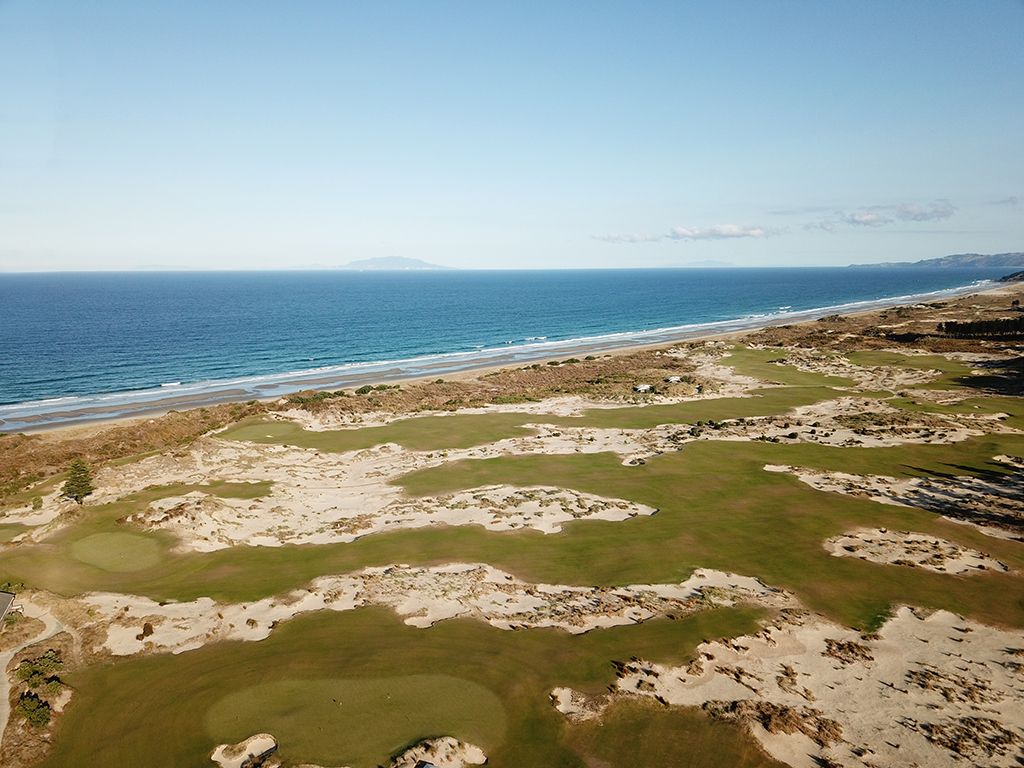
What makes Tara Iti so difficult to rank against its peers, in the ordinary sense of comparing courses that thousands of golfers have played and formed opinions about, is precisely how few golfers have ever had the chance to play it. This is an intensely private club, with a global membership numbering somewhere in the region of only 150 people, drawn from across the golf-obsessed corners of the world rather than concentrated locally. Guest access follows a strict member-introduction policy: a visitor cannot simply call the club and book a tee time, however willing they might be to pay for the privilege. Entry requires a personal introduction from an existing member, and even then visitor access remains extremely limited by design rather than by accident. The club operates an exclusive lodge on the property, Tara Iti Lodge, offering accommodation for members and their invited guests, reinforcing the sense that this is conceived less as a golf course with a clubhouse attached and more as a private retreat built around a golf course, in the manner of the most rarefied clubs in the United States rather than a conventional destination resort.
That exclusivity has, if anything, amplified rather than dampened the course's reputation. Architecture critics and golf publications that have gained access consistently place Tara Iti among the finest courses built anywhere in the world in the current century, with some assessments ranking it among the very best courses on the planet full stop, not merely the best of the modern era. It is frequently cited as one of the fastest courses in the sport's history to climb into the uppermost tier of global rankings after opening, a testament both to the extraordinary quality of the Te Arai site and to the precision of Doak's routing across it. That speed of ascent is itself a rare kind of credential: plenty of new golf courses generate enthusiasm in their first year or two before settling into a more modest reputation once the initial excitement fades, but Tara Iti's standing has, by all accounts, only solidified over time as more of the small community of people qualified to judge world-class golf architecture have found their way onto the property.
- Architect: Tom Doak
- Opened: 2015
- Par 72, 7,153 yards
- Setting: Pacific duneland, Te Arai coast, north of Auckland, New Zealand; also a Little Tern shorebird nesting site
- Membership: approximately 150 members worldwide
- Access: member introduction required; extremely limited visitor access; Tara Iti Lodge available to members and guests
- Nearest airport: Auckland (AKL), approximately 88km, roughly a 75-minute transfer
Doak's career, spanning decades and continents, has been defined by a handful of recurring convictions that show up again and again at Tara Iti: that width off the tee is not a concession to weaker players but a strategic tool in its own right, since a wide fairway allows an architect to reward the correct angle of approach rather than merely the correct distance; that greens should present multiple viable pin positions rather than a single fair target, so that the same hole can play completely differently across different rounds; and that a golf course should be walked and studied for a long time before a single tee is cut, so that the routing follows the land's own logic rather than a preconceived template. Te Arai gave him a canvas unusually well suited to all three convictions simultaneously, sandy and free-draining enough to support the firm turf that makes width meaningful, undulating enough to generate a huge variety of green complexes without excessive shaping, and large enough that a routing genuinely responsive to the terrain, rather than forced onto it, was actually possible from the very first planning stages.
Among the holes most frequently singled out by the small community that has played Tara Iti are several of its short holes, where Doak is often at his most inventive, using dramatically different green shapes, approach angles, and surrounding contours to keep four or five short par threes across a single round from ever feeling repetitive. The course's closing stretch, working back toward the clubhouse and the lodge, is described as building tension methodically rather than through a single dramatic set piece in the way Cabot Cliffs does with its 16th, a difference in temperament that reflects the two architectural approaches rather well: Coore and Crenshaw's Cape Breton course peaks with visual astonishment, while Doak's New Zealand course rewards sustained, patient attention to strategy across all eighteen holes, the kind of design that architecture critics describe as improving on replay rather than overwhelming on a first viewing. That is, in its own way, an even harder trick to pull off, since it depends on quality that only reveals itself over repeated exposure, precisely the kind of exposure that Tara Iti's exclusivity makes so difficult for most golfers, however well travelled, to ever obtain.
For the overwhelming majority of golfers reading about it, Tara Iti will remain a course experienced only through photographs, architecture criticism, and the occasional secondhand account from a fortunate friend of a member. That is, in a sense, entirely the point, and it is worth being honest about rather than pretending otherwise. Unlike Cabot Cliffs, which welcomes paying resort guests, or Fancourt, which sells day passes at a premium, Tara Iti was built to be a private sanctuary first. Its presence on this list is not an invitation so much as an acknowledgment: golf architecture's most exclusive and hardest-to-reach modern address is also, by the near-unanimous judgment of those who have actually played it, one of the three or four best golf courses built anywhere in the world in the last quarter-century, and any serious accounting of the pinnacle of modern links design has to include it, reachable or not.
Fancourt – The Links, George, Western Cape, South Africa
The first thing to understand about Fancourt's Links course is that there is no ocean anywhere near it. This sets it apart from every other course on this list, and indeed from almost every other course that would ever plausibly be described as a links in the traditional sense of the word, since the term originally referred specifically to the sandy coastal ground linking farmland to the sea. The Links at Fancourt sits inland, in George, on South Africa's spectacular Garden Route along the southern coast of the Western Cape, part of the four-course Fancourt Estate that also includes the Montagu, Outeniqua, and Bramble Hill courses. It is described, accurately, as South Africa's most celebrated man-made links, and that phrase, man-made links, is not a contradiction to be glossed over but the entire reason the course deserves serious attention. What Gary Player and his design and construction team achieved here was not merely building a good golf course on flat land; it was manufacturing, essentially from nothing, the full sensory and strategic experience of a seaside links course on ground that offered none of the natural preconditions for one.
Access to Fancourt is refreshingly straightforward by the standards of this list. George has its own airport, George Airport (GRJ), sitting only around 8km from the estate, translating to a transfer time of roughly 15 minutes, making Fancourt one of the most conveniently reached elite golf destinations anywhere in the world. Golfers can fly into Cape Town, connect on a short domestic hop to George, and be standing on the first tee of the Links within a couple of hours of touching down in the country, a logistical ease that neither Cabot Cliffs nor Tara Iti can match given their remote, weather-exposed locations at the ends of long overland or connecting journeys.
The story of how the Links course came to exist is worth telling in some detail, because it is genuinely one of the more remarkable engineering feats in modern golf construction. Gary Player, one of the towering figures of twentieth-century professional golf and by the time of this project already an experienced and prolific course designer, was given a flat parcel of land at Fancourt with essentially no topographical character to work with, no natural dunes, no coastal exposure, none of the raw material that architects like Coore, Crenshaw, or Doak rely on when shaping a links course elsewhere on this list. Rather than building a conventional parkland course suited to that flat terrain, Player's design team set out to recreate the specific look, feel, and playing characteristics of a genuine seaside links from scratch. That meant moving an enormous volume of earth, sculpting rolling dune-like contours across land that had previously been essentially featureless, importing and shaping sandy soil profiles to support the firm, fast-draining turf conditions that authentic links golf depends on, and building in the visual language of links golf, revetted bunkers, undulating fairways, run-off areas around greens, almost entirely through deliberate construction rather than by uncovering anything that was already there. The course opened in 2000, and it stands today as one of the most famous and most frequently cited examples anywhere in the world of a fully manufactured links, a category of golf course design that few architects have attempted with anything like this level of ambition or resources, and fewer still have pulled off as convincingly.
Playing the course, the illusion holds up remarkably well. The Links stretches to a substantial par 73 and 7,565 yards from the back markers, making it comfortably the longest and most physically demanding course discussed in this feature, a length that reflects both Player's own preference for testing championship-calibre golf and the course's history as a tournament venue capable of examining the best players in the world. Fairways roll and heave in convincing imitation of natural dune movement, greens sit within contoured surrounds that funnel and repel approach shots in the manner of a genuine coastal course, and the design incorporates water features and strategically placed bunkering that force considered decision-making on nearly every hole rather than simply rewarding raw power. Wind, ironically for an inland course, still plays a meaningful role in how the Links is experienced, since the Garden Route's weather patterns bring their own variability across the open, largely treeless layout, reinforcing rather than undermining the links character the design set out to achieve.
Fancourt is proof that a great links doesn't have to be born by the sea. It can be built, hole by hole, by a designer who understands exactly what a links is supposed to feel like underfoot.
The course's single most famous moment in the wider public consciousness of golf arrived in 2003, when Fancourt's Links hosted the Presidents Cup, the biennial team competition pitting a United States team against an International team drawn from outside Europe. That edition of the Presidents Cup produced one of the most dramatic conclusions in the tournament's history: the entire contest came down to the final singles match on the course, a head-to-head duel between Tiger Woods and Ernie Els that went to extra holes as fading light closed in over the Garden Route. With darkness making further play impossible and no resolution reached, the match, and with it the entire Presidents Cup, was declared a tie, the first and to date only tie in the event's history. That finish cemented the Links course's place in golf history well beyond the world of architecture criticism, giving it a moment of genuine sporting drama that neither Cabot Cliffs nor Tara Iti, for all their architectural brilliance, can claim in quite the same way. It also served as global validation of Player's design: a course built from flat land through sheer engineering ambition proved itself capable of hosting, and thoroughly examining, two of the greatest golfers of their generation under the pressure of a live team competition.

What makes the Links exceptionally difficult starts with its sheer scale. At 7,565 yards it demands genuine length off the tee, and Player's bunkering scheme punishes wayward drives severely, funnelling misses into positions that leave awkward angles into greens that are themselves defended by subtle but persistent contouring. Unlike the more minimalist, restraint-driven design philosophies of Coore, Crenshaw, and Doak elsewhere on this list, Player's approach at Fancourt is more overtly strategic and penal in places, reflecting his own background as a relentlessly competitive major champion who built courses to examine the very best players rather than to prioritise pure aesthetic subtlety above all else. That is not a criticism; it is simply a different, equally valid design tradition, and the fact that the course could host a tournament as fiercely contested as the 2003 Presidents Cup and produce a result that dramatic is itself the strongest possible evidence that the examination it poses is a fair and searching one. The beauty of the course lies less in the raw natural drama of a clifftop or a wild dune coastline, since there is none to draw on here, and more in the sheer completeness of the illusion: from the first tee to the eighteenth green, a golfer walking the property with no prior knowledge of the site's history would have every reason to believe they were playing a course shaped by nature over centuries, rather than one shaped by heavy machinery over a matter of a few years at the end of the twentieth century.
Fancourt's reputation among architecture critics and well-travelled golfers reflects both of these dimensions, the design achievement and the tournament pedigree. It is consistently regarded as the finest man-made links course anywhere in the world and one of the very best golf courses on the entire African continent, frequently discussed alongside South Africa's finest natural courses despite its entirely artificial origins, a remarkable state of affairs for a course barely a quarter-century old built on land with no natural golf character whatsoever. As with the other two courses in this feature, exact numerical rankings shift year to year across different publications, but the qualitative standing has remained consistent: among people who study golf course architecture seriously, Fancourt's Links is treated as a landmark achievement in the specific, difficult art of building convincing links golf where nature provided none of the raw materials.
- Architect: Gary Player
- Opened: 2000
- Par 73, 7,565 yards
- Setting: flat inland terrain reshaped into dune-like contours, George, Garden Route, Western Cape, South Africa
- History: host venue of the 2003 Presidents Cup, decided by the tournament's first-ever tie (Woods vs Els)
- Part of the four-course Fancourt Estate (with Montagu, Outeniqua, and Bramble Hill)
- Nearest airport: George Airport (GRJ), approximately 8km, roughly a 15-minute transfer
The Fancourt Estate around the Links is itself worth understanding, since the man-made links is only one piece, albeit the most celebrated one, of a larger golf-and-resort ecosystem that Player and the property's developers built over the same period. The Montagu course, an earlier Player design on more conventional parkland terrain among indigenous forest and a meandering river, and the shorter, more relaxed Outeniqua course, together with the estate's own par-3 Bramble Hill layout, mean that a golf trip to Fancourt can extend comfortably across several rounds of genuinely varied golf without a guest ever leaving the property, something none of the other two courses on this list can offer in quite the same self-contained way. That breadth has helped Fancourt establish itself as one of the anchor golf destinations of the Garden Route trip that many international visitors build their South African itinerary around, typically combining a few days at Fancourt with wildlife viewing further along the coast or inland, and it means the Links course, however forbiddingly it plays, exists within a resort culture explicitly built around welcoming travelling golfers rather than shutting them out.
Access for visiting golfers sits between the other two courses on this list in terms of restriction. Fancourt's Links is not a private members' club in the manner of Tara Iti, but neither is it freely open to any passing golfer. Play is primarily reserved for guests staying at the Fancourt hotel and estate, with day-guest access available to non-residents at a premium rate when availability allows, and the Links is consistently described as the most sought-after and most restricted of the estate's four courses, the one most likely to be fully booked and the one guests are advised most strongly to reserve well in advance of arrival rather than hoping to arrange something on the ground. For golfers planning a Garden Route trip with Fancourt's Links as the centrepiece, the practical advice from those who have made the journey is consistent: book the round, and ideally the accommodation package that gives priority access to it, as early as the itinerary allows.
Three Courses, One Standard
Placed side by side, Cabot Cliffs, Tara Iti, and Fancourt's Links tell a story about how varied the modern links tradition has become since architects and developers first began looking beyond the British Isles for spectacular sites and ambitious budgets. Cabot Cliffs proves that natural clifftop drama, married to a design philosophy built on restraint and patience, can produce a golf course that feels inevitable, as though it had always existed on that Cape Breton headland waiting to be found. Tara Iti proves that the very same restraint, applied to a different but equally extraordinary piece of Pacific duneland, can produce a course so refined that it climbed into the uppermost tier of world rankings faster than almost any course in the sport's history, even while remaining almost entirely closed off from the golfing public that reveres it from a distance. And Fancourt's Links proves something different again, and in its own way more radical: that the essential character of links golf, the firm turf, the strategic ground game, the visual language of dune and revetted bunker, need not depend on proximity to the sea at all, if a designer with Gary Player's championship pedigree and the will to move an extraordinary volume of earth sets out to build it from nothing.
None of the three courses is trying to be St Andrews or Royal County Down, and none of them should be judged by how closely they replicate the specific holes or history of those older grounds. They represent instead what links golf looks like when it is allowed to keep evolving, carried forward by architects and designers with the imagination, the sites, and the resources to push the tradition into landscapes its original inventors never had access to. Whether that evolution reaches a Cape Breton clifftop, a protected New Zealand shorebird sanctuary, or a reshaped stretch of the South African Garden Route, the underlying standard has not moved: firm ground, honest wind, and holes that ask a golfer to think as hard as they swing. Readers who want to go further into just how demanding this modern breed of links golf can get should look for the companion feature elsewhere in this site's journal covering the ten hardest links courses in the world, which ranges considerably further afield than the three courses celebrated here and makes the case, in painstaking detail, for exactly how punishing the modern links experience can become at its most extreme.
More From the Journal
Rankings
The 10 Hardest Links Golf Courses in the World
Blind tee shots, pot bunkers deep enough to lose a career in, and wind that turns a 400-yard par 4 into an all-out fight — these are the ten toughest links courses on earth.
Links Golf 101
What Makes Links Golf So Special?
Wind that never blows the same way twice, ground so firm the ball runs forever, greens that punish the smallest miss — why links golf is unlike any other version of the game.