
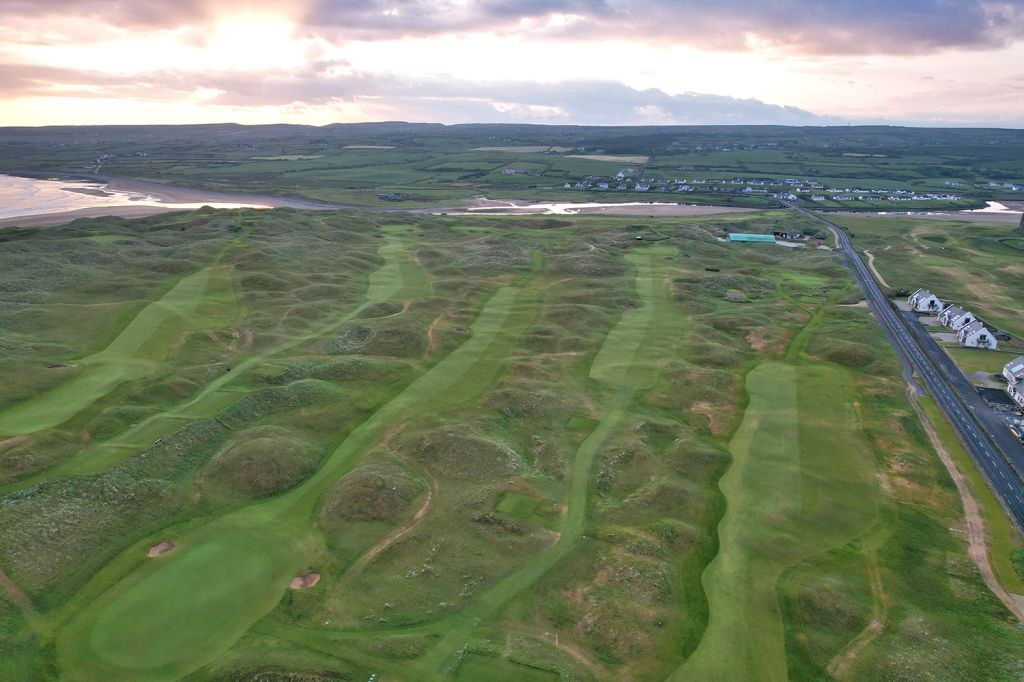
Stand on the first tee at a course carved from old dune land, and the first thing you notice is not the fairway but the sky — how low it sits, how fast it moves, how the light shifts color between the moment you pull your driver and the moment you actually swing it. Golf here doesn't begin with a scorecard; it begins with a negotiation with the weather, the ground, and centuries of terrain that no earthmover designed.
This is links golf, and it plays unlike any other golf on the planet. On a parkland course in Georgia or Surrey, you can generally trust your yardage book: this many yards to the pin, this club, done. On a links course shaped by wind and tide along the coasts of Scotland, Ireland, England, and increasingly the Pacific Northwest, the yardage book is a starting point and often not a particularly useful one. Wind, ground, and the run of the ball rewrite the equation on every hole, every day, sometimes every hour.
To understand why golfers cross oceans specifically to play these courses — often in weather that would send a parkland club home for the day — you have to understand what links golf actually asks of a player, and how different that is from the game most people learn on manicured, irrigated, tree-lined courses inland. This isn't a stylistic preference. It's a fundamentally different examination wearing the same scorecard.
None of what follows is nostalgia for its own sake, either. Every element that defines links golf — the terrain, the wind, the turf, the bunkers, the greens — traces back to a single set of physical facts about a specific kind of coastal ground, and each of those facts has a direct, explainable effect on how the game has to be played on top of it. Understanding the mechanism behind links golf, rather than simply admiring the scenery, is what turns a single round into a genuine education, and it's why the same handful of courses keep drawing golfers back decade after decade rather than being crossed off a list and forgotten.
What Actually Makes a Course a Links
The word "links" gets used loosely in golf marketing — plenty of courses with a view of the water call themselves links whether or not the description holds up. A genuine links course isn't a style choice or an aesthetic; it's a description of terrain. True links land is the sandy, dune-covered strip that lies between the beach and the more fertile farmland further inland — ground too poor and too salt-blown to grow crops, but perfect, once golf came along, for the game. It's this specific geography, and not a set of design tropes borrowed from it, that produces almost everything else this article will describe.
That terrain was built by nature over an extraordinarily long timescale, not shaped in a single construction season. As sea levels shifted over thousands of years, wind and tide pushed sand into ridges and dunes, and the resulting land settled into humps, hollows, and ridgelines with a randomness no algorithm would generate on purpose. Marram grass and fescue took root in the poor, sandy soil because almost nothing else could survive there, binding the dunes together while leaving the surface lean, firm, and fast-draining. Early golfers didn't so much design these courses as discover playable routes through ground that already existed, threading holes between natural humps and hollows rather than bulldozing new ones into place.
Where the Word Comes From
The word itself traces back to the Scots "hlinc," meaning rising ground or a ridge — the same root behind the older English sense of "link" as a piece of ridged land. In Scotland, "the links" referred to the rough, undulating common ground between a town and its shore, unsuited to farming and used instead for grazing, rabbit warrens, and eventually golf. That's why so many of the oldest clubs in the game — St Andrews chief among them — sit on land simply called "the links," rather than on a golf course later renamed for marketing purposes. The geography came first; the game grew into it.
This matters because it explains why links golf feels different underfoot, not just to the eye. A course built by moving a few million cubic yards of earth on a former farm field can look convincingly like a links from a drone photograph — fescue rough, a scattering of pot bunkers, a stacked-sod face here and there. But genuine links turf, grown on truly sandy, well-drained soil that has been settling and firming for centuries, behaves in ways that are difficult to fully replicate on reclaimed or trucked-in sand. The ground itself is the architect's real material, and on a true links, that ground has had a very long time to become what it is.
- Sandy, free-draining soil built up over centuries of wind and tide, not moved in during construction
- Location on the strip of land between farmland and the sea, historically too poor to farm
- Native fescue and marram grasses rather than lush, irrigated turf
- Dune ridges and hollows that existed long before the first hole was ever routed
- Few or no trees, since the ground and salt air were historically inhospitable to them
This origin also shaped a design philosophy that later architects would spend a century trying to formalize into words: find the golf holes that already exist in the land, and disturb as little as possible getting them into play. The men who first laid out the great links courses weren't landscape architects in any modern sense; they were golfers who walked the ground, noticed where a natural plateau made a fair green site or where a valley between two dunes made an obvious fairway, and staked out a route accordingly. Later refinements added strategy and variety, but the essential move was always closer to curation than creation — which is precisely why so much of the terrain still feels unplanned, because in the strictest sense, most of it was.
The Wind Writes a New Course Every Day
If sandy soil is the foundation of links golf, wind is its constant, restless collaborator. Exposed courses on open coastline rarely enjoy a truly calm day, and even a "calm" day by links standards would be considered breezy almost anywhere else. A player who tees off in a gentle morning breeze and returns in the afternoon might find the same par four playing a full club or two longer, the same approach needing to start twenty yards left of where it went that morning, the same green suddenly impossible to hold with anything but a low runner.
This changes club selection in a way inland golf simply doesn't demand. On a sheltered parkland course, a 150-yard shot is a 150-yard shot today and most days — pick the club that flies that distance and commit. On an exposed links, 150 yards downwind with the flag tucked behind a swale might call for a knocked-down eight-iron, pitched well short and let run; the same 150 yards straight into the wind might call for a four-iron or even a fairway wood, punched low to stay beneath the worst of the gusts. Gusts well in excess of 30 miles an hour are not unusual on an exposed Scottish or Irish links, and on those days the wind isn't a background condition — it's the primary opponent, more influential on the outcome of a round than any bunker or green complex.
This is also why the same links hole never really repeats itself. A hole that plays as a gentle, driveable short par four with the wind at your back in the morning can turn into a brutal three-shot slog into a headwind by afternoon, demanding an entirely different strategy, entirely different clubs, and an entirely different tempo. Play the same course on consecutive days with the wind out of a different quarter and half the holes will ask new questions you didn't face the day before. That quality is what keeps serious golfers returning to the same links courses year after year — not nostalgia, but the fact that the course genuinely isn't the same course twice.
Contrast this with a fixed inland test, however well designed. A parkland course built for target golf is engineered to play consistently: the yardages are fixed, the greens receive shots from roughly the same trajectory every day, and the primary variable is the player's own form. That consistency has its own virtues — it rewards precision and allows a course to be "solved" through repetition and local knowledge. Links golf resists being solved. The wind guarantees that even a golfer who has played the same links a hundred times will still be improvising, still recalculating, still genuinely thinking through the shot in front of them rather than executing a memorized number.
Wind also changes how a ball has to be flighted, not just which club delivers the right distance. Into a strong headwind, a shot hit with the golfer's normal, mid-height trajectory can balloon upward and lose enormous amounts of distance, so better links players deliberately flatten their swing and take spin off the ball to keep it under the worst of the gust, sacrificing a little control for a shot that actually reaches its target. Downwind, the opposite concern applies: too much spin and loft and the ball can get caught up and carried well past the intended landing area, so the shot has to be flighted low and allowed to run out rather than held up in the air. Neither adjustment is intuitive to a player raised on still-air, target-style golf, and both take real repetition to trust under pressure.
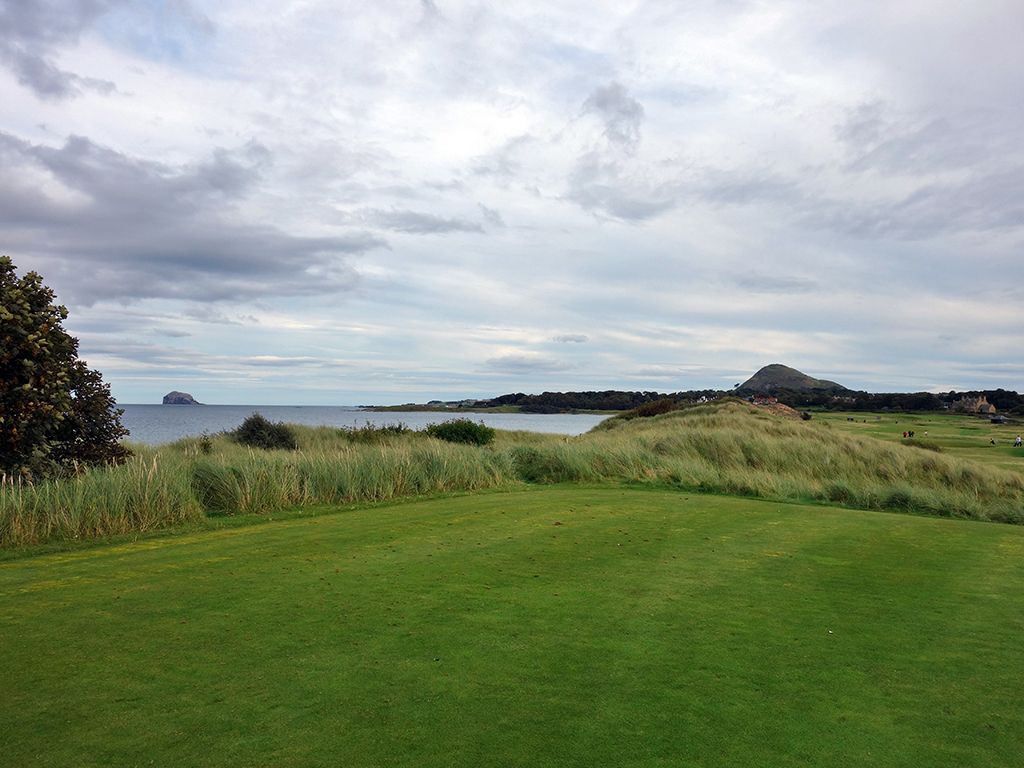
Many of the oldest links are also routed with the prevailing wind deliberately in mind, sending golfers out along the coast into one direction for the first stretch of holes and back in the other for the second, a layout sometimes described as "out and back" rather than the looping routes common on inland courses. That structure means a round often splits cleanly into two contrasting halves: nine holes fighting a headwind that feels endless, followed by nine holes where the same wind turns into a helpful push, or vice versa depending on the day. It's a simple piece of routing, but it concentrates the wind's influence rather than diluting it, and it's part of why a links round can feel like two entirely different rounds stitched together.
Firm Ground and the Art of the Running Ball
The other defining physical trait of links golf, alongside the wind, is what happens to the ball once it lands. Fescue fairways rooted in sandy, free-draining soil are firm almost by definition — there's little moisture held near the surface, and the turf itself grows tight and wiry rather than lush and cushioned. A well-struck drive on a dry links fairway doesn't simply land and stop; it lands, kicks, and keeps rolling, sometimes for a startling distance, gathering extra yardage that a golfer used to soft American fairways has to learn to expect rather than be surprised by.
That extra roll changes strategy well beyond simple distance. On a course where the ball runs, slopes and contours in the fairway become part of the shot rather than incidental scenery — a well-placed drive can use a helping slope to kick forward an extra ten or fifteen yards, while a shot that misses its line by only a few feet can be diverted by a hidden hump into a fairway bunker or a stretch of gorse that a straighter ball would have avoided entirely. Reading a links tee shot means reading the ground ahead of you almost as carefully as reading the wind above you.
The same principle governs approach shots and short game, and it's here that links golf departs most sharply from the target-golf style that dominates much of American inland golf. On soft, irrigated greens surrounded by lush rough, the standard approach is a high, spinning shot that lands close to the pin and stops quickly — a style perfectly suited to overhead sprinklers and receptive turf. On a firm, exposed links green fronted by humps and hollows, that same high shot is often the wrong answer: it can be blown offline by wind on the way up, and it may not even hold once it lands on ground with little give. The better play is frequently a low, running approach — sometimes a full club or two less than the yardage suggests, landed well short of the flag and allowed to release along the ground toward the hole.
This opens up a style of shot-making that simply doesn't exist, or barely exists, on softer courses: the bump-and-run from well off the green, the deliberate use of a slope to feed a ball sideways toward a hole it can't be attacked directly, the low punch played into a bank so it pops up and trickles rather than flies. It rewards creativity and course knowledge over raw power, and it's a large part of why so many accomplished target-golf players struggle the first time they encounter a proper links — the shots they've spent years perfecting are, on this ground, often the wrong tool for the job.
- The bump-and-run, landed well short of the target and released along the ground
- The knock-down punch shot, kept low to beat a crosswind rather than fight through it
- Deliberately using fairway humps and slopes to redirect the ball toward a hidden target
- Putting from well off the green, where firm turf is often truer and faster than the surrounding rough or fringe
Fescue itself deserves a word here, because it's doing more work than golfers often credit. Compared with the bentgrass and Bermuda varieties common on inland fairways, fescue grows fine, dense, and low in nutrient demand, thriving precisely in the lean, sandy conditions that would starve richer turf types. It needs less water, less fertilizer, and less maintenance overall, which is part of why traditional links clubs have historically kept their fairways firmer by choice as much as by necessity — a lush, fescue fairway is almost a contradiction in terms. The trade-off is a ball that sits down less willingly and runs more eagerly, which is exactly the character that makes the ground game possible in the first place.
Playable Almost Every Month of the Year
One of the more counterintuitive facts about links golf, especially to visitors from regions where winter means a closed golf course, is that the same sandy soil producing that running ball also keeps the course playable through months when inland courses turn to mud. Heavy rain that would leave a clay-based parkland fairway waterlogged for days simply drains through free-draining sandy soil within hours. Puddles rarely form; casual water is rare; and the turf itself, adapted over centuries to sit above a natural drainage system, holds up to foot traffic in conditions that would force a soft inland course to rope off fairways or shut entirely.
This is why so many of the game's most famous links towns — on the Scottish east coast, along the Irish Sea, in exposed corners of England — keep their courses open essentially year-round, weather rather than turf condition being the real obstacle. Compare that to the typical clay-based parkland course, which often closes for weeks or months over winter simply because the ground can't take carts, foot traffic, or mowing equipment without turning into mush. A links course might be cold, windswept, and genuinely uncomfortable in January, but it will rarely be unplayable in the way a waterlogged inland course becomes unplayable.
There's a practical travel implication buried in this fact that's easy to overlook: a links-focused golf trip has a far wider viable season than one built around inland parkland golf. Firm, fast conditions in cooler months can, for many golfers, actually be preferable to the softer turf of peak summer — the ball runs further, the course plays a touch shorter off the tee even as wind and cold add their own challenge, and both crowds and green fees tend to ease outside the height of summer. The same drainage that makes links golf strategically distinctive also makes it, in a very literal sense, more available.
None of this means links golf is immune to the calendar entirely. Growth slows in the coldest months, greens can be topdressed with sand to protect them, and some clubs rotate temporary greens or tees into use during the harshest stretches of winter to spread wear. But these are maintenance adjustments layered onto a course that remains fundamentally open and walkable, not the wholesale closures that heavier, wetter turf often requires. For a traveling golfer weighing when to book a trip, that difference can be the deciding factor between a course that's an option in November and one that simply isn't.
Bunkers Built to Punish
Nowhere is the difference between links golf and inland golf more viscerally obvious than in the bunkers. A parkland sand trap is usually a shallow, groomed hazard that a competent player can escape with a wedge and a two-putt in mind. A links pot bunker is a different proposition entirely: small, round, often startlingly deep, with steep faces built up from stacked layers of turf — a technique known as revetting — that can leave a ball sitting well below the level of the surrounding ground, sometimes with the flag not even visible from inside the bunker.
These bunkers were rarely placed by a designer sketching a hazard onto a plan; many began as natural blowouts in the dune land, hollows scoured out by wind where sheep once sheltered from the weather, later reinforced with stacked turf faces to stop them eroding further. That origin explains their scale and placement — they weren't sized to be fair, because nothing about the land they came from was designed to be fair. Carnoustie's bunkering is frequently cited by players as some of the most punishing in the game precisely because of how it combines depth with position, catching shots that look perfectly sound in the air. Royal County Down, across the Irish Sea, is known for blind pot bunkers scattered across its fairways and hillsides that a player often can't even see until standing over the ball, trusting a caddie's line or their own memory of the hole rather than anything visible from the tee.
The genuinely punishing thing about a deep revetted pot bunker isn't just the sand — it's the geometry. When the face of the bunker stands taller than the shot needed to escape it, the only sensible play is often sideways, back toward the fairway, or in the most severe cases backward, away from the green entirely, sacrificing a stroke simply to get back into open space. Players who try to be heroic and blast toward the pin from beneath a steep revetted lip regularly compound one dropped shot into two or three, which is exactly the deterrent effect these bunkers are built to create: the smart play, however unsatisfying, is usually the conservative one.
This is a deliberately different philosophy from bunkering built primarily to look attractive from a fairway or a clubhouse window. Links bunkers are functional first and photogenic second, shaped by wind and by golfers digging themselves out for more than a century, rather than by a bunker rake and a construction crew working from a rendering. Their randomness — some barely a stride across, others cavernous — is part of what makes them feel like genuine hazards rather than decoration.
Placement matters as much as depth. Because these bunkers frequently sit in exactly the spots where a well-struck ball naturally comes to rest — at the base of a slope, in the flattest part of a landing area, on the direct line to a green — avoiding them often means deliberately steering away from the most obvious target line, favoring an angle that looks less inviting off the tee but leaves a cleaner look at the green. That's a subtler, more patient kind of course management than simply picking the widest strip of fairway and aiming down the middle, and it's a large part of what separates a golfer who understands links strategy from one who is merely surviving it.
Greens That Demand Imagination
Links greens tend to be smaller, firmer, and far more exposed to the wind than the large, lush, well-irrigated greens found on most modern inland courses. Because they sit on the same free-draining sandy base as the rest of the course, they're built to shed water quickly, which means they also shed golf balls quickly — a shot that lands even a few feet off its intended line, or with even slightly too much speed, is liable to run through the green, off the side, or down a slope into a hollow well away from the pin.
Contours on these greens are rarely subtle. Ridges, tiers, and false fronts are common, often inherited directly from the natural humps in the dune land the green was built on rather than sculpted in afterward, and a putt that looks straightforward from twenty feet can be pushed several feet off line by a ridge invisible from the golfer's eye level. Because greens are frequently elevated, exposed, and firm, holding an approach shot on the putting surface at all is often the primary challenge, well before a player even starts thinking about the line of the putt.
This changes short-game strategy fundamentally. On a soft green surrounded by rough, the standard recovery from just off the putting surface is a lofted wedge, spun to stop near the hole — a shot that depends on the ball gripping quickly on impact. On a firm links green with a tightly mown run-off in front of it, that same lofted shot can be the wrong choice; there's often not enough grip in the turf for spin to matter, and the ball can bound past the hole regardless of how much backspin is applied. Better players around a links green routinely putt from well off the putting surface, or play low chip shots designed to release and climb a slope rather than fly directly at the flag — reading the ground the way a snooker player reads a table, rather than simply flying the ball at the target and trusting spin to do the rest.
The upshot is that a strong short game on a links course looks different from a strong short game inland. It rewards imagination, feel, and a willingness to play a shot that looks unconventional but accounts for how the ground will actually behave, over a repertoire of standard, high-percentage wedge shots that assume soft, receptive turf. Players who arrive expecting to get up and down with a lofted wedge from every position often find their scores suffer until they adjust their whole conception of what a short-game shot is supposed to look like.
Some of the oldest links courses go a step further and share a single, enormous green between two different holes — a tradition most famously associated with the Old Course at St Andrews, where several double greens serve both an outward and an inward hole at once. Putting across one of these shared surfaces can mean a putt of considerable length simply to reach the correct section of green, let alone the hole, and it's another reminder that the greens on a links were never designed around a single approach shot from a single direction. They were built, or discovered, to serve the whole rhythm of a round, not just the moment a wedge lands.
Wind reaches the putting green as well, and it's one of the more disorienting adjustments for a first-time links player. A firm, closely mown surface offers little resistance, so a strong gust can genuinely move a ball at rest, or at minimum make a golfer standing over a putt feel unsteady enough to affect the stroke itself. Rules of golf make specific allowance for a ball that's actually moved by wind on the green, which tells you how real and how anticipated the problem is. Reading a links putt, then, is never purely a matter of slope and grain; it's slope, grain, firmness, and a live assessment of exactly how much the wind in that moment is likely to nudge the ball off the line a still-air read would suggest.
A Landscape Shaped by Nature, Not Machinery
Because true links courses are routed through terrain that existed long before anyone thought to play golf on it, the ground itself is far less uniform than on a course engineered from scratch. Fairways tumble over dune ridges and drop into hollows; stances are frequently uneven, requiring a player to strike a full shot from a ball noticeably above or below their feet, or from a slope that pushes weight onto one side of the body mid-swing. None of this was planned the way a modern architect plans a fairway's cross-slope for drainage and playability — it's simply what the land was doing before the first hole was ever routed across it.
Blind shots are a natural consequence of this terrain, and they remain one of the more debated features of links golf among modern golfers used to seeing every hazard laid out clearly from the tee. A tee shot played directly over a dune ridge, with the fairway and any hazards on it entirely hidden from view, asks a player to trust a marker post, a caddie, or their own memory rather than their eyes. Purists tend to defend blind shots as an essential, honest part of playing genuinely natural terrain — a course built on land this dramatic was always going to hide some of its hazards, and learning to play it, hole by hole and visit by visit, is part of the experience rather than a design flaw to be engineered away.
This is the crux of the difference between a links routed through real dune land and a modern course that merely borrows links aesthetics on flatter, more manageable ground. On the latter, uneven stances and blind shots can feel arbitrary, inserted for character rather than emerging naturally from the terrain. On genuine duneland, they feel inevitable — the land was always going to move like this, and the course had no real alternative but to work with it. That inevitability is a large part of why these courses reward repeat visits: learning where the blind hazards sit, how a particular slope kicks a ball, which uneven stance calls for a flatter swing, is knowledge that can only be earned by actually playing the course, not read off a scorecard.
Uneven ground also changes the physical experience of walking a links course, and that's not a minor detail. Fairways that climb over a dune ridge and drop back down on the other side mean a round frequently involves real elevation change packed into a relatively compact footprint, quite different from the flatter, more evenly graded walk of a typical parkland eighteen. Add in wind resistance on the more exposed stretches, and a links round can be a genuinely demanding walk even before the golf itself is considered — part of the reason caddies and trolleys remain so common at these clubs, and part of the reason players often describe feeling more thoroughly worked over by a links round than by a similar-length round on gentler terrain.
A links course was never built. It was found — and then, very carefully, left mostly alone.

Local knowledge becomes genuinely valuable in this kind of terrain in a way it rarely does elsewhere in golf, which is part of why caddies remain such a fixture at the great links clubs. A caddie who has walked the same dunes for decades isn't simply carrying a bag; they're carrying a memory of exactly where a blind second shot needs to be aimed, which false front will reject an approach that looks perfectly struck, and how a particular hollow plays when the wind comes from the northeast rather than the west. That knowledge is earned the slow way, round after round, in a landscape that doesn't reveal itself fully from a single look at the scorecard or a flyover video.
The Visual Drama of Links Golf
Beyond the strategic substance, there is a purely sensory register on which links golf operates that inland courses, however manicured, rarely reach. Dune grass and marram move visibly in even a light wind, so the whole landscape seems to be in gentle motion around a stationary golfer. The light along an exposed coastline changes constantly — a hole that looked flat and gray under cloud cover can turn gold and sharply shadowed the moment the sun breaks through, throwing the humps and hollows of the fairway into relief in a way a static photograph never quite captures.
It's a landscape that engages more than the eyes. Gorse in bloom carries a distinct coconut-like scent across a fairway on a warm afternoon; the smell of salt air intensifies the closer a hole runs to the shoreline; gulls and other seabirds work the dunes and occasionally interrupt a backswing with a sudden call from somewhere just out of sight. None of it is scored, and none of it appears on a yardage book, but it's a large part of why a round on a great links tends to stay in the memory with unusual clarity — the golf and the place it happened in are fused together in a way that's harder to achieve on a course that could, geographically speaking, be almost anywhere.
Kingsbarns, on Scotland's east coast near St Andrews, is often cited for exactly this quality — holes routed along the shoreline that put the sea in view from nearly every tee, fairways rolling down toward rocky coastline and back up toward elevated greens, so that the golf and the scenery are never really separable from one another.

Half a world away, Pacific Dunes at the Bandon Dunes Resort on the Oregon coast demonstrates that this quality isn't unique to Scotland or Ireland — it belongs to any coastline with the right sandy geology and the will to build sympathetically with it rather than against it. Carved into dramatic dune ridges above the Pacific, it's frequently held up as proof that modern architecture, at its best, can still produce the tumbling, wind-scoured, naturalistic feel of century-old British and Irish links, rather than a manicured approximation of one.

What ties these places together visually, whether the course is a few hundred years old or a few decades, is the sense that the golf hole is a guest on the landscape rather than its author. Nothing about a good links hole looks like it was engineered to look natural — it looks natural because, to a very large extent, it is.
The Truest Test in Golf
Add all of this together — terrain shaped by centuries rather than a construction schedule, wind that rewrites strategy hole to hole, ground that rewards low shots and imagination over aerial precision, bunkers and greens that punish carelessness without needing artificial length, and a landscape too dramatic and irregular to have been drawn on a plan — and it becomes clear why so many purists regard links golf as the truest test the sport offers. It doesn't rely on distance or difficulty for their own sake. It relies on a golfer's ability to read conditions, adapt on the spot, and accept that the smart shot is often not the most aggressive one.
It's also worth noting how much this style has shaped golf course architecture well beyond the coasts where it originated. A minimalist movement in modern design — one that favors routing holes through existing land contours, using firm turf and ground-game options, and resisting heavy earthmoving wherever the site allows it — owes an obvious debt to the old links, even when the resulting course sits nowhere near an ocean. Pacific Dunes is one of the clearer examples of that debt being repaid in kind: a genuinely modern golf course that plays, looks, and rewards a player in a manner its designers clearly studied in Scotland and Ireland long before ever breaking ground in Oregon.
That's also why links golf rewards travel in a way few other forms of the game do. A single visit to a great links course, played in one set of wind and weather, only tells part of the story; the same course under a different wind, on a different day's weather, is close to a different examination altogether. It's a form of golf that resists being fully captured on a screen or in a single scorecard, and that resistance is, for many travelers, the entire appeal — a reason to go back rather than a reason to feel finished with a place after one round.
For golfers curious about which courses represent the highest expression of this style, a companion piece on this site's journal ranks the top three links courses in the world, while a separate piece takes on the other side of the question, working through the ten hardest links courses a traveling golfer is likely to encounter. Between the two, they offer a reasonably complete picture of where this particular version of the game is played at its most rewarding, and at its most demanding — useful reading for anyone starting to plan a trip built around this singular, wind-shaped form of golf.
More From the Journal

Rankings
The 10 Hardest Links Golf Courses in the World
Blind tee shots, pot bunkers deep enough to lose a career in, and wind that turns a 400-yard par 4 into an all-out fight — these are the ten toughest links courses on earth.
Rankings
The Top 3 Links Golf Courses in the World
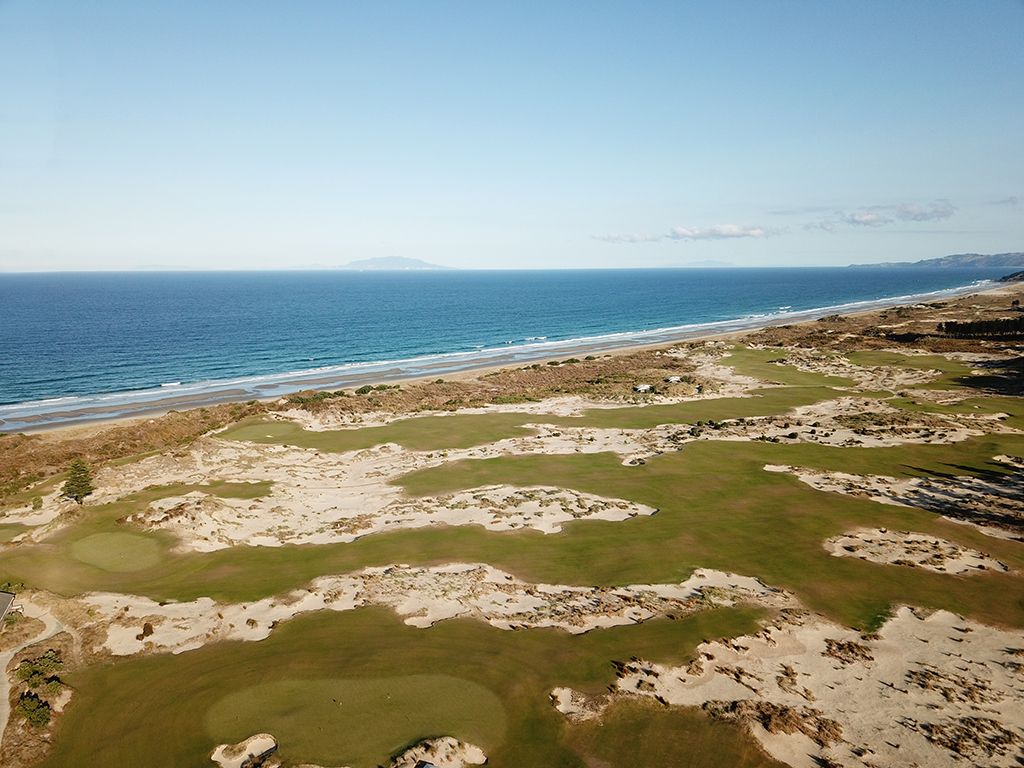
From the cliffside drama of Cabot Cliffs in Nova Scotia to the wind-carved dunes of Tara Iti in New Zealand and Gary Player's inland links masterpiece at Fancourt — our pick of the three greatest links courses on the planet.